
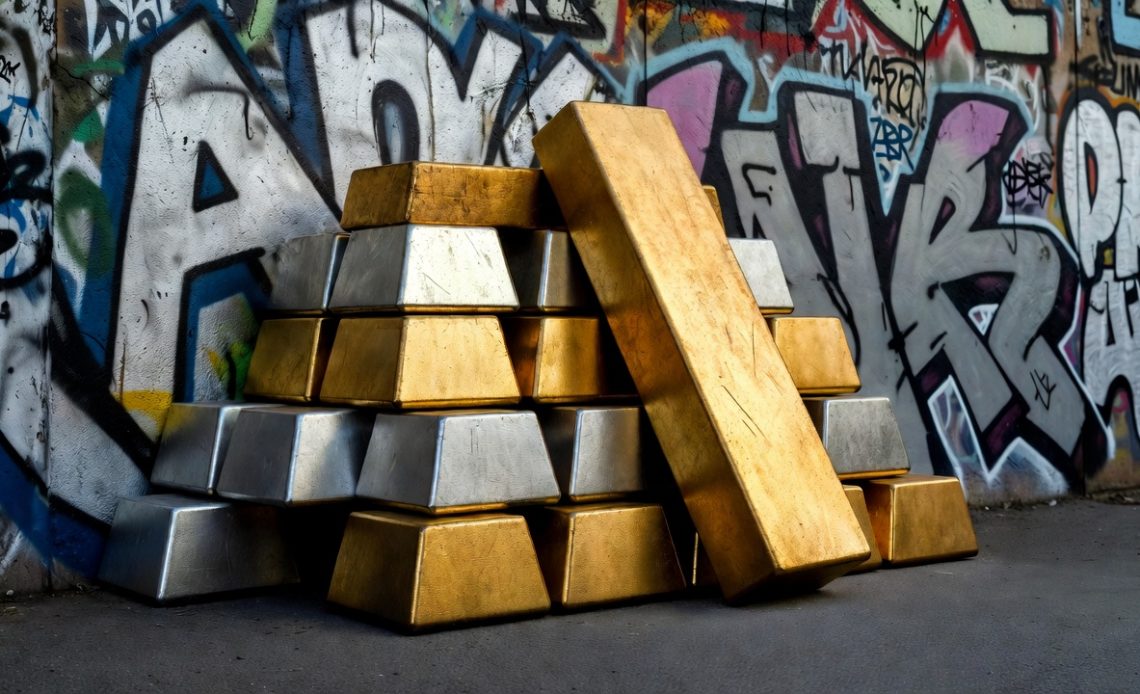
For a while now, experts have said that gold and silver prices may experience significant corrections before moving higher. But it seems as though the precious metals did not get the memo.
Both precious metals have hit historic highs in the past couple of trading days.
On Friday, silver prices crossed the $100 per ounce mark for the first time ever on the back of increasing safe-haven demand.
Meanwhile, gold prices on COMEX breached the coveted $5,000 per ounce level on Monday.
Experts believe that the rallies could continue as fundamentals remained strongly in favour of both metals.
At the time of writing, the COMEX gold contract was at $5,125.66 per ounce, up 2.2%. The contract had hit a record high of $5,145.39 an ounce earlier in the day.
Silver prices hit a record high of $109.320 per ounce on Monday, and were trading at $107.670 per ounce.
Gold and silver continued their strong upward momentum from the start of the year, with both metals extending their already robust performance from 2025.
More room for upside
Gold has increased by approximately 17%, and silver has seen a significant climb of 50%.
“The move has been driven by a series of geopolitical shocks. They include uncertainty about Washington’s stance on Greenland and lingering concerns about a potential US-Iran escalation,” Ewa Manthey, commodities strategist at ING Group, said in a note.
A weaker dollar, lower real yields, and persistent policy uncertainty have reinforced investor appetite for hard assets.
Meanwhile, Goldman Sachs had recently increased its gold price projection for December 2026, raising the forecast from $4,900 to $5,400.
In a separate projection, independent analyst Ross Norman anticipated a high of $6,400 for gold this year, with an expected average price of $5,375.
Bank of America has set an aggressive forecast among major institutions for the yellow metal, raising its near-term gold target to a staggering $6,000 per ounce.
On the other hand, Bank of America’s Head of Metals Research Michael Widmer suggested that silver may be particularly attractive to investors who are willing to accept higher risk in exchange for greater potential gains.
He points to the current gold:silver ratio of about 59 as an indicator that silver could continue to outperform gold.
To illustrate the potential upside for silver, Widmer referenced the historical ratio low of 32 in 2011, which would imply a silver price of $135 per ounce.
Furthermore, the 1980 low of 14 in the ratio suggests an even higher potential silver price of $309 per ounce.
Investment demand
“We expect investment demand to remain the most important support for the gold market in the current year,” Barbara Lambrecht, commodity analyst at Commerzbank AG, said in a report.
The rally may pause in the short term, mainly because the dispute over Greenland seems temporarily settled.
Furthermore, the US Federal Reserve is expected to keep its key interest rates at their current level.
“However, we expect interest rate cuts in the US to accelerate in the course of the year following the appointment of a new Fed chair,” Lambrecht added.
This should give the gold price a boost again.
The decision regarding the new Fed chair appointment, to be made by US President Donald Trump, is expected soon. Former Fed Governor Warsh is currently seen as the most likely candidate.
Retail investors’ demand for investment has increased substantially in recent months. This is evidenced by the 2025 inflows into gold-backed exchange-traded funds (ETFs) reaching their highest level since 2020.
Amid ongoing skepticism regarding the dependability of the conventional 60/40 portfolio split, gold is attracting increased investor interest.
Research, according to Widmer, now suggests that allocating 20% of a portfolio to gold can be a successful approach.
Silver’s strength
The gold-silver ratio has fallen to its lowest point since 2011, hovering just above 50.
This demonstrates silver’s current strength, which is driven by a combination of persistent safe-haven interest and strong industrial demand.
“Silver’s smaller market size and dual role as both an industrial and investment metal continue to amplify price volatility,” ING’s Manthey said.
Also, tightening physical balances amid constrained mine‑supply growth are adding further upward pressure.
Despite ongoing market volatility, the underlying environment for silver and gold remains strong.
Factors such as geopolitical tensions, central bank purchases, and structural supply shortages are contributing to their favorable positioning.
Manthey added:
Silver’s tight physical market and strong industrial demand should continue to provide a solid floor, though its elevated volatility means sharp swings remain likely.
However, risks persist for silver prices, according to Manthey. Specifically, a more severe global economic downturn or consistently elevated prices could lead to demand destruction, particularly in industrial sectors.
“Silver’s inherent volatility also means it can overshoot in both directions,” Manthey further said.
The post Analysis: gold breaches $5,000, silver tops $100; experts see more gains appeared first on Invezz