
Boeing narrowed its third-quarter net loss as revenue increased and its defense business delivered stronger results.
Shares of Boeing (BA) edged up about 1% in premarket trading following the release.
The company reported revenue of $24.19 billion, up 4% from a year earlier and above the analyst consensus estimate of $23.84 billion, according to LSEG data.
Its adjusted loss was 34 cents per share, wider than Wall Street’s expected loss of 21 cents.
Boeing reported a net loss of $116 million, or 26 cents per share, for the three months ended September 30.
That compared with a loss of $5.34 billion, or $7.14 per share, a year earlier, when the manufacturer recorded a nearly $5 billion charge related to its delayed 777X aircraft program.
Free cash flow reached $464 million, exceeding analyst estimates of $325.1 million.
Chief Executive Officer Kelly Ortberg said Boeing still has work to do as it attempts to improve operational performance, stabilize aircraft production and rebuild confidence among regulators and customers.
Defense sales provide support
Boeing’s defense business delivered one of the strongest performances during the quarter, with revenue increasing 15% year-over-year to $7.94 billion.
The defense segment has provided support as Boeing works to address operational challenges in its commercial aircraft business.
The manufacturer has also secured a significant opportunity in the defense market, with the US Navy selecting Boeing to develop its next-generation fighter jet.
However, stronger defense revenue was not enough to prevent adjusted earnings from missing Wall Street expectations.
Commercial aircraft business remains under pressure
Revenue in Boeing’s commercial airplanes division fell 3% from a year earlier to $10.72 billion.
The unit reported a negative operating margin of 6.5%, reflecting a less favorable delivery mix, higher projected costs associated with future production-rate adjustments and increased estimated supply-chain costs.
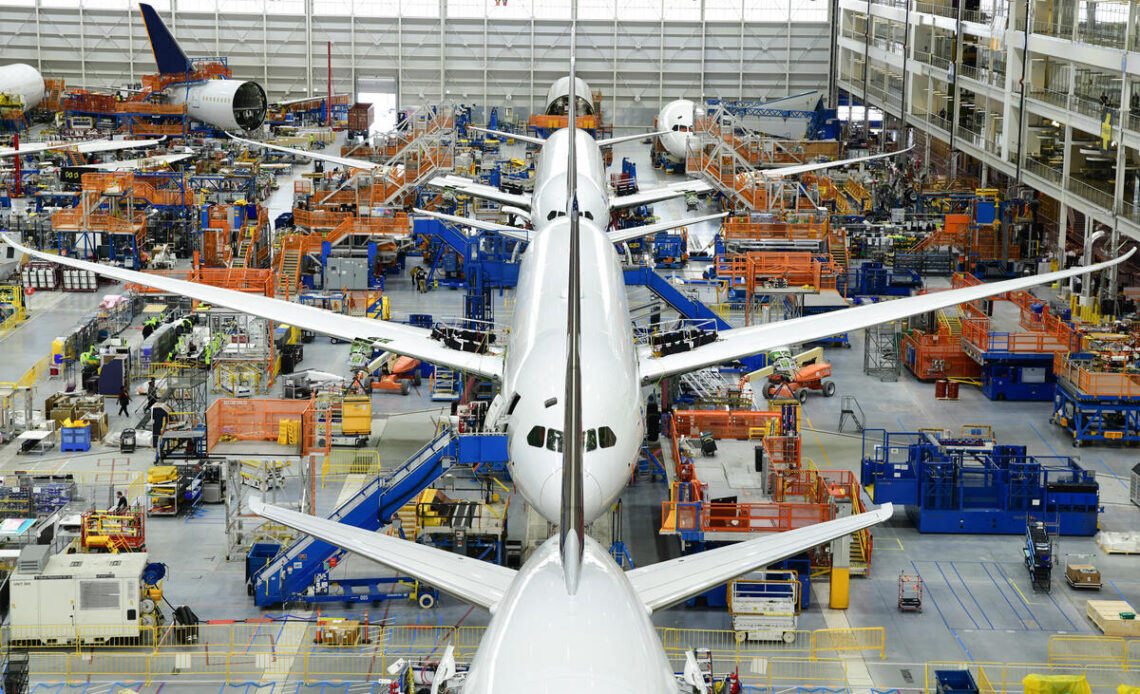
Boeing delivered 161 commercial aircraft during the third quarter, just one more than in the same period last year.
Production and deliveries remain central to the company’s financial recovery because customers pay the bulk of an aircraft’s purchase price when they take delivery.
Boeing has been producing around 47 of its 737 Max aircraft per month but has yet to stabilize output at that rate sufficiently to advance its production plans.
Ortberg said in September that the stabilization process was taking longer than expected, while the company has indicated that it expects to increase output next year.
Engine delivery constraints have also limited production increases for the 737 Max and 787 Dreamliner.
In September, Ortberg said Boeing had not yet achieved the engine delivery performance required to increase production of the 787 to 10 aircraft per month from its current pace of eight.
The company is expected to provide investors with an update on its production targets and recovery plans during its quarterly earnings call.
Balance sheet remains a priority
Since Ortberg took over in 2024, Boeing has been working to repair its balance sheet, restore regulatory confidence and increase production of its core commercial aircraft models.
The company reported $45.9 billion in consolidated debt, unchanged from the previous quarter. It also said it had access to $10 billion in undrawn credit facilities.
Boeing has been selling non-core assets to support its financial position, including the sale of its Jeppesen business to Thoma Bravo and the recent disposal of its stake in HRL Laboratories.
Despite these efforts, the debt burden and the capital required to stabilize production remain important considerations for investors.
Boeing’s results come ahead of Airbus’s scheduled earnings report.
The European manufacturer has maintained an advantage over Boeing in aircraft deliveries but has also faced quality-control and supply-chain problems this year.
The post Why Boeing stock is up 1% after posting a $116M loss appeared first on Invezz